
Euro tumbles sharply, gap between France-German yields widen
- Euro faces intense selling pressure against its major currency peers due to increased French fiscal concerns.
- The gap in yields between France and German has increased significantly.
- 10-year French bond yields have increased almost 28% in the last two months.
The Euro (EUR) underperforms its major currency peers at the start of the week, weighed down by increased fiscal risks in France amid surging costs on public finances and political instability.
Euro Price Today
The table below shows the percentage change of Euro (EUR) against listed major currencies today. Euro was the weakest against the Japanese Yen.
| USD | EUR | GBP | JPY | CAD | AUD | NZD | CHF | |
|---|---|---|---|---|---|---|---|---|
| USD | 0.65% | 0.20% | -0.06% | 0.13% | 0.04% | 0.52% | 0.17% | |
| EUR | -0.65% | -0.40% | -0.67% | -0.48% | -0.42% | -0.20% | -0.43% | |
| GBP | -0.20% | 0.40% | -0.29% | -0.08% | -0.02% | 0.19% | -0.03% | |
| JPY | 0.06% | 0.67% | 0.29% | 0.20% | 0.21% | 0.49% | 0.26% | |
| CAD | -0.13% | 0.48% | 0.08% | -0.20% | 0.02% | 0.27% | 0.03% | |
| AUD | -0.04% | 0.42% | 0.02% | -0.21% | -0.02% | 0.22% | 0.00% | |
| NZD | -0.52% | 0.20% | -0.19% | -0.49% | -0.27% | -0.22% | -0.24% | |
| CHF | -0.17% | 0.43% | 0.03% | -0.26% | -0.03% | 0.00% | 0.24% |
The heat map shows percentage changes of major currencies against each other. The base currency is picked from the left column, while the quote currency is picked from the top row. For example, if you pick the Euro from the left column and move along the horizontal line to the US Dollar, the percentage change displayed in the box will represent EUR (base)/USD (quote).
France’s Finance Minister (FM) Roland Lescure has vowed to reduce its budget deficit from a target of 5% of economic output next year to the European Union (EU) limit of 3% by 2029. However, financial experts doubt that the current minority government would do so, being a minority government.
Analysts at BBH said in a note that they “doubt the proposal will clear parliament without significant concessions,” underscoring the political hurdles to meaningful consolidation. Such a scenario would push French fiscal troubles back to the square.
Meanwhile, the gap of yields on public finances offered in Germany and France has widened significantly. 10-year yields on France bond yields are up 0.65% to near 4.89% at press time. They posted a fresh multi-decade high near 5% on Friday. French 10-year bond yields have gained over 28% in the last two months. As of writing, 10-year yields on German Bunds are down 1.26% to near 3.41%. In the last two months, German 10-year Bund yields have increased over 10%.
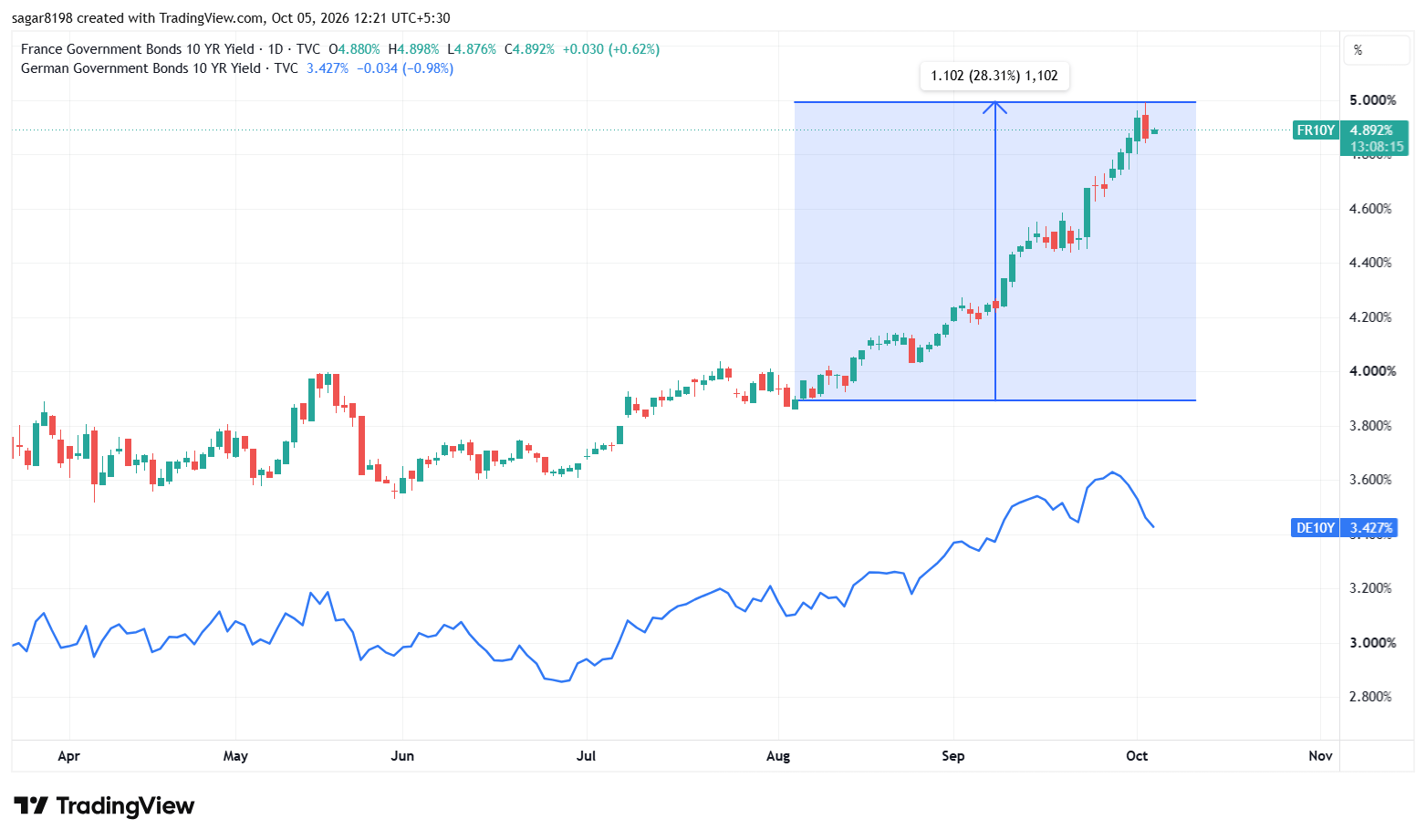
(Chart showing 10-year Yields on bonds from France and Germany)
Weakening Euro could increase the competitiveness of its exports in the global market, but at the same time will prompts the cost of imported goods. This could create more troubles for the European Central Bank (ECB) policymakers are already fighting against energy crisis-led inflation risks.
Later in the day, investors will focus on ECB Chief Economist Philip Lane’s speech, which is scheduled at 08:00 GMT.
Meanwhile, heightening French risk concerns have improved the safe-haven appeal of the Swiss Franc. This week, investors will focus on the Swiss Unemployment Rate data for September, which will be released on Tuesday.
Euro FAQs
The Euro is the currency for the 20 European Union countries that belong to the Eurozone. It is the second most heavily traded currency in the world behind the US Dollar. In 2022, it accounted for 31% of all foreign exchange transactions, with an average daily turnover of over $2.2 trillion a day. EUR/USD is the most heavily traded currency pair in the world, accounting for an estimated 30% off all transactions, followed by EUR/JPY (4%), EUR/GBP (3%) and EUR/AUD (2%).
The European Central Bank (ECB) in Frankfurt, Germany, is the reserve bank for the Eurozone. The ECB sets interest rates and manages monetary policy. The ECB’s primary mandate is to maintain price stability, which means either controlling inflation or stimulating growth. Its primary tool is the raising or lowering of interest rates. Relatively high interest rates – or the expectation of higher rates – will usually benefit the Euro and vice versa. The ECB Governing Council makes monetary policy decisions at meetings held eight times a year. Decisions are made by heads of the Eurozone national banks and six permanent members, including the President of the ECB, Christine Lagarde.
Eurozone inflation data, measured by the Harmonized Index of Consumer Prices (HICP), is an important econometric for the Euro. If inflation rises more than expected, especially if above the ECB’s 2% target, it obliges the ECB to raise interest rates to bring it back under control. Relatively high interest rates compared to its counterparts will usually benefit the Euro, as it makes the region more attractive as a place for global investors to park their money.
Data releases gauge the health of the economy and can impact on the Euro. Indicators such as GDP, Manufacturing and Services PMIs, employment, and consumer sentiment surveys can all influence the direction of the single currency. A strong economy is good for the Euro. Not only does it attract more foreign investment but it may encourage the ECB to put up interest rates, which will directly strengthen the Euro. Otherwise, if economic data is weak, the Euro is likely to fall. Economic data for the four largest economies in the euro area (Germany, France, Italy and Spain) are especially significant, as they account for 75% of the Eurozone’s economy.
Another significant data release for the Euro is the Trade Balance. This indicator measures the difference between what a country earns from its exports and what it spends on imports over a given period. If a country produces highly sought after exports then its currency will gain in value purely from the extra demand created from foreign buyers seeking to purchase these goods. Therefore, a positive net Trade Balance strengthens a currency and vice versa for a negative balance.