
Indian Rupee starts positive as oil prices fall further
- The Indian Rupee opens higher against the US Dollar at the start of the week.
- Lower oil prices bring relief for the Indian currency.
- Investors keenly await meeting between the US and Gulf nations this week.
The Indian Rupee (INR) starts the week on a positive note against the US Dollar (USD). The USD/INR pair drops to near 95.75 as the Indian currency gains due to continuous support from correcting oil prices.
In the opening session, the MCX Crude Oil contract expiring today (September 21) is down 2.7% to Rs. 9,400.
Currencies from economies, such as India, which rely heavily on oil imports to meet their energy needs, tend to outperform in a correcting oil price environment.
Oil eases as China seeks Iran’s help and Saudi pipeline capacity returns
Oil prices have been under pressure for over a week due to improving hopes of an increase in energy supply from Saudi Arabia.
Strategists at DBS observe that oil prices are "easing a tad" following reports that China has requested Iran to help rein in Houthi attacks on behalf of Saudi Arabia. They add that Saudi Arabia is now restoring its East–West pipeline to the Red Sea coast after damage from earlier attacks and "aims to return to half of its capacity," helping to alleviate some immediate supply concerns even as regional risks remain in focus.
US and Gulf nations to hold talks at UN General Assembly
US President Donald Trump confirms a meeting with leaders from Gulf Nations and top Iranian leaders to attend the United Nations (UN) General Assembly beginning later in the day. Leaders will likely discuss various ways to increase the supply of energy products from the Middle East.
Ahead of the meeting, US President Trump has dropped three options before Iran while speaking in an interview with Fox News over the weekend that he could destroy the country, allow it to collapse economically, or seek a diplomatic resolution, while predicting that "very big things are going to be happening in the not-so-distant future," The Economic Times reported.
India inflation rise keeps October rate hike in focus
Analysts at MUFG note that India’s August inflation “rose 4.8% yoy (DBSf 4.9%) from a revised 4.5% month before, firmest since December 2024,” highlighting a clear firming in price pressures. They argue that “a gradual broadening of price pressures is likely to keep headline inflation above 5% in the second half of the fiscal year, underscoring the need for a tighter policy bias.” MUFG adds that “recent developments, including a sustained rise in crude prices, tightening global financial conditions, firm domestic growth and signs of broadening in core pressures, strengthen the case for a shallow 50-bp hike in the second half of FY27, making October’s meeting a live one.”
USD/INR Technical Analysis
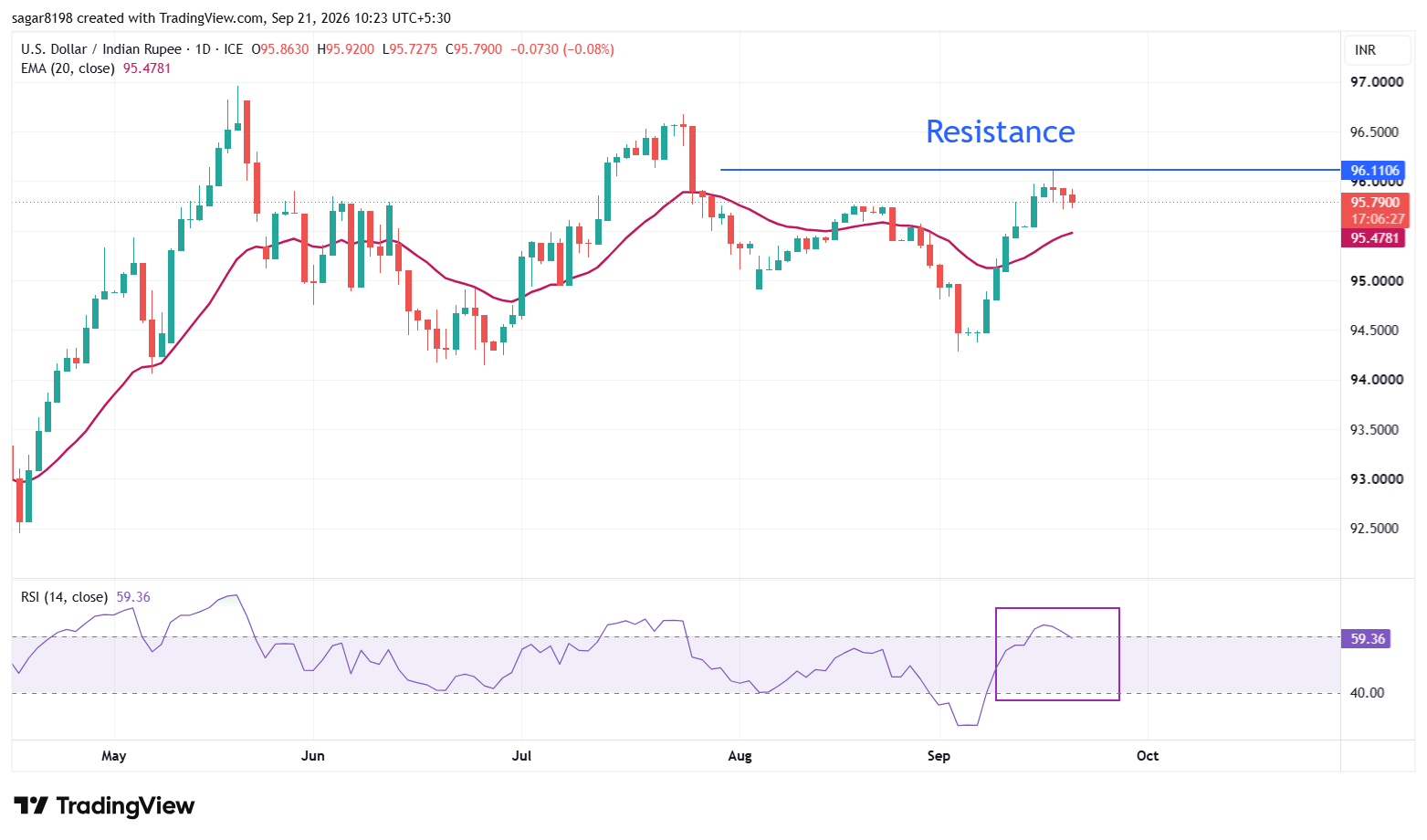
In the daily chart, USD/INR trades at 95.75. The pair holds above its recent moving average structure, with price comfortably above the 20-day exponential moving average (EMA) at 95.48, which now sits as underlying trend support despite being recorded below current spot.
The Relative Strength Index (RSI) near 60.00 stays in positive territory, suggesting that upside momentum remains constructive while avoiding outright overbought conditions.
On the topside, the previous week's high at 96.10 is the key hurdle for the pair. On the downside, any pullback toward the EMA zone is likely to attract buyers as long as RSI holds above the 50 line, with a loss of that area needed to hint at a deeper corrective phase.
(The technical analysis of this story was written with the help of an AI tool. Know more.)
Indian Rupee FAQs
The Indian Rupee (INR) is one of the most sensitive currencies to external factors. The price of Crude Oil (the country is highly dependent on imported Oil), the value of the US Dollar – most trade is conducted in USD – and the level of foreign investment, are all influential. Direct intervention by the Reserve Bank of India (RBI) in FX markets to keep the exchange rate stable, as well as the level of interest rates set by the RBI, are further major influencing factors on the Rupee.
The Reserve Bank of India (RBI) actively intervenes in forex markets to maintain a stable exchange rate, to help facilitate trade. In addition, the RBI tries to maintain the inflation rate at its 4% target by adjusting interest rates. Higher interest rates usually strengthen the Rupee. This is due to the role of the ‘carry trade’ in which investors borrow in countries with lower interest rates so as to place their money in countries’ offering relatively higher interest rates and profit from the difference.
Macroeconomic factors that influence the value of the Rupee include inflation, interest rates, the economic growth rate (GDP), the balance of trade, and inflows from foreign investment. A higher growth rate can lead to more overseas investment, pushing up demand for the Rupee. A less negative balance of trade will eventually lead to a stronger Rupee. Higher interest rates, especially real rates (interest rates less inflation) are also positive for the Rupee. A risk-on environment can lead to greater inflows of Foreign Direct and Indirect Investment (FDI and FII), which also benefit the Rupee.
Higher inflation, particularly, if it is comparatively higher than India’s peers, is generally negative for the currency as it reflects devaluation through oversupply. Inflation also increases the cost of exports, leading to more Rupees being sold to purchase foreign imports, which is Rupee-negative. At the same time, higher inflation usually leads to the Reserve Bank of India (RBI) raising interest rates and this can be positive for the Rupee, due to increased demand from international investors. The opposite effect is true of lower inflation.